Nara · 奈良県
Nara
奈良
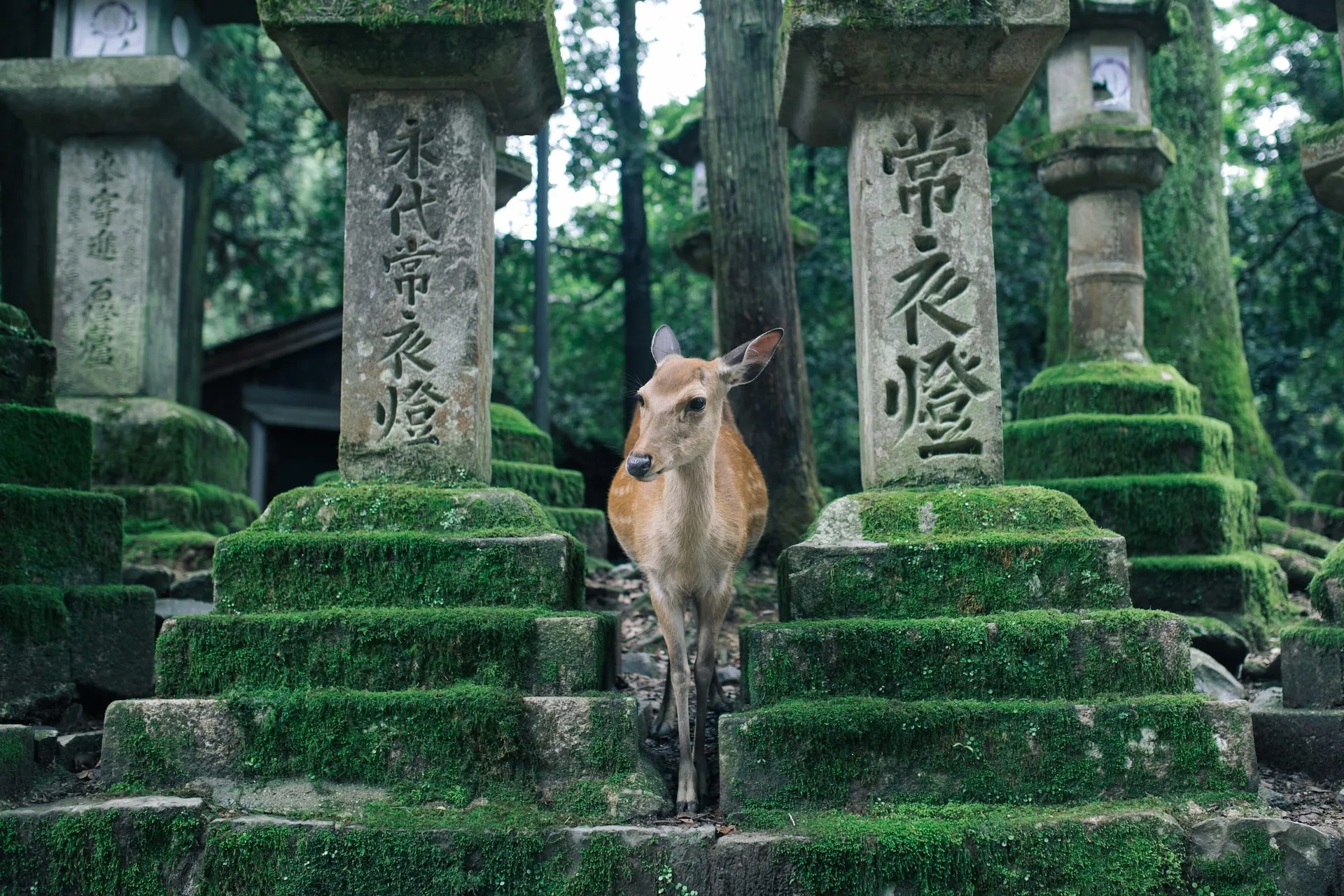
Nara is a compact cultural route centered on temple landmarks, shrine forest, and the open park landscape around the old capital.
Tour Stops
Todai-ji
Home to the Daibutsu — a 15-meter-tall bronze Buddha statue that is the largest in Japan and one of the largest in the world. The hall that houses it, Daibutsuden, was the world’s largest wooden building for centuries (the current structure, rebuilt in 1709, is actually 30% smaller than the original). Founded in 745 by Emperor Shomu as the head temple of all provincial Buddhist temples in Japan, Todai-ji was the religious and political center of Nara when the city served as Japan’s capital. A pillar inside the hall has a hole at its base the same size as the Buddha’s nostril — squeezing through is said to bring enlightenment in the next life.
Nara Park
A vast, open park that connects Nara’s major temples and shrines, home to over 1,200 wild sika deer that roam freely and have been considered divine messengers of the gods since ancient times. The deer are remarkably tame — visitors can buy special deer crackers (shika-senbei) from vendors, and many of the deer will bow before accepting them (a learned behavior mimicking the bowing of visitors). The park’s lantern-lined paths wind through grassy lawns, past ancient ponds, and under towering trees, creating a landscape that feels more like a sacred forest than an urban park. During the Shika-no-Tsunokiri (antler-cutting ceremony) each October, the deer become part of a Nara tradition dating back to 1671.
Kasuga Taisha
Founded in 768 AD as the shrine of the powerful Fujiwara clan, Kasuga Taisha is approached through a forest path lined with nearly 3,000 stone and bronze lanterns — donated over centuries by worshippers. Twice a year, during the Mantoro festival (February and August), all 3,000 lanterns are lit simultaneously, transforming the shrine into a sea of flickering light. The shrine buildings themselves are painted in vivid vermillion and rebuilt every 20 years in the Shinto tradition of renewal (though this practice was suspended in the modern era). The primeval forest surrounding the shrine has been protected from logging for over a thousand years, making it one of the oldest preserved forests in Japan.
Kofuku-ji
Once one of the most powerful temples in Japan, Kofuku-ji was the family temple of the Fujiwara clan and at its peak in the 8th century had over 175 buildings. Today, the five-story pagoda (Japan’s second tallest at 50 meters) dominates the Nara skyline and is reflected in the adjacent Sarusawa Pond — one of the city’s most classic views. The temple’s National Treasure Hall houses extraordinary Buddhist sculptures, including the famous three-headed, six-armed Ashura statue from 734 AD, widely considered one of the most beautiful Buddhist sculptures ever created.
Naramachi
The old merchant quarter of Nara, where narrow lanes wind between preserved Edo-period machiya (wooden townhouses) that have been converted into small museums, craft workshops, cafés, and galleries. The district’s compact layout dates back to the medieval period, and many buildings still show the distinctive deep, narrow “eel’s bed” floor plan designed to minimize street-front tax while maximizing interior space. Small red cloth monkeys (migawari-zaru) hang from the eaves of many houses — charms that take on misfortune in place of the residents. It’s a slow, wandering stop that reveals Nara’s human-scale character after the grand temples.
Nearby Combinations